A Powerful Essay from a young Asian American

A friend of mine recently share this article with me.  It’s a powerful essay from a young Asian American in a time when racial divisiveness is at an all time high. Please share the link.


Taken from this source.  https://chineseamerican.org/p/31571

Content warning: White supremacy, racial stereotypes, violence

To the Chinese American Community:


My name is Eileen Huang, and I am a junior at Yale University studying English. I was asked to write a reflection, maybe even a poem, on Chinese American history after watching Asian Americans, the new documentary on PBS. However, I find it hard to write poems at a time like this. I refuse to focus on our history, our stories, and our people without acknowledging the challenges, pain, and trauma experienced by marginalized people—ourselves included—even today. In light of protests in Minnesota, which were sparked by the murder of George Floyd at the hands of racist White and Asian police officers, I specifically want to address the rampant anti-Blackness in the Asian American community that, if unchecked, can bring violence to us all.


We Asian Americans have long perpetuated anti-Black statements and stereotypes. I grew up hearing relatives, family friends, and even my parents make subtle, even explicitly racist comments about the Black community: They grow up in bad neighborhoods. They cause so much crime. I would rather you not be friends with Black people. I would rather you not be involved in Black activism.


The message was clear: We are the model minority—doctors, lawyers, quiet and obedient overachievers. We have little to do with other people of color; we will even side with White Americans to degrade them. The Asian Americans around me, myself included, were reluctant—and sometimes even refused—to participate in conversations on the violent racism faced by Black Americans—even when they were hunted by White supremacists, even when they were mercilessly shot in their own neighborhoods, even when they were murdered in broad daylight, even when their children were slaughtered for carrying toy guns or stealing gum, even when their grieving mothers appeared on television, begging and crying for justice. Even when anti-Blackness is so closely aligned to our own oppression under structural racism.


We Asian Americans like to think of ourselves as exempt from racism. After all, many of us live in affluent neighborhoods, send our children to selective universities, and work comfortable, professional jobs. As the poet Cathy Park Hong writes, we believe that we are “next in line … to disappear,” to gain the privileges that White people have, to be freed from all the burdens that come with existing in a body of color.


However, our survival in this country has always been conditional. When Chinese laborers came in the 1800s, they were lynched and barred from political and social participation by the Chinese Exclusion Act—the only federal law in American history to explicitly target a racial group. When early Asian immigrants, such as Bhagat Singh Thind, attempted to apply for citizenship, all Asian Americans were denied the right to legal personhood—which was only granted to “free white persons“—until 1965. When Pearl Harbor was bombed, Japanese Americans were rounded up, tortured, and detained in concentration camps. When the Cold War reached its peak, Chinese Americans suspected of being Communists were terrorized by federal agents. Families lost their jobs, businesses, and livelihoods. When COVID-19 hit the US, Asian Americans were assaulted, spat on, and harassed. We were accused of being “virus carriers”; I was recently called a “bat-eater.” We are made to feel like we have excelled in this country until we are reminded that we cannot get too comfortable—that we will never truly belong.


Here’s a story of not belonging: On June 19, 1982, as Detroit’s auto industry was deteriorating from Japanese competition, Vincent Chin, a 27-year-old Chinese American, entered a bar to celebrate his upcoming wedding. Ronald Ebens, a laid-off White autoworker, and his stepson, Michael Nitz, were there as well. They followed Chin as he left the bar and cornered him in a McDonald’s parking lot, where they proceeded to bludgeon him with a metal baseball bat until his head cracked open. “It’s because of you motherf––ers that we are out of work,” they had said to Chin. Later, as news of the murder got out, Chinese Americans were outraged, calling for Ebens and Nitz’s conviction. Chin’s killers were only charged for second-degree murder, receiving only charges of $3,000—and no jail time. “These weren’t the kind of men you send to jail,” County Judge Charles Kaufman said. Then who is?


Watching Asian Americans, I was haunted by the video clips of Chin’s mother, Lily. She is a small Chinese woman who looks like my grandmother, or my mother, or an aunt. Her face crumples in front of the cameras; she pleads and cries, in a voice almost animal-like, “I want justice for my son.” Yet, in all of Lily’s footage, she is surrounded by Black civil rights activists, such as Jesse Jackson. They guard her from news reporters that try to film her grief. Later, they march in the streets with Chinese American activists, holding signs calling for an end to racist violence.


Though we cannot compare the challenges faced by Asian Americans to the far more violent atrocities suffered by Black Americans, we owe everything to them. It is because of the work of Black Americans—who spearheaded the civil rights movement—that Asian Americans are no longer called “Orientals” or “Chinamen.” It is because of Black Americans, who called for an end to racist housing policies, that we are even allowed to live in the same neighborhoods as White people. It is because of Black Americans, who pushed back against racist naturalization laws, that Asian Americans have gained official citizenship and are officially recognized under the law. It is because of Black activism that stories like Vincent Chin’s are even remembered. We did not gain the freedom to become comfortable “model minorities” by virtue of being better or hard-working, but from years of struggle and support from other marginalized communities.


On May 25, 2020, George Floyd, a Black man, was accused of using a counterfeit 20-dollar bill at a deli in Minneapolis. In response, Derek Chauvin, a White police officer, tackled Floyd and knelt on his neck for seven minutes. In videos that will later circulate online, for three minutes, in a pool of his own blood, Floyd is seen pleading for his life, stating that he can no longer breathe. Instead, Chauvin continues to kneel. And kneel. Meanwhile, in the background, Tou Thao, an Asian American police officer, is seen standing by the murder, merely watching. And watching. And saying nothing as Floyd slowly stops struggling.


I see this same kind of silence from Asian Americans around me. I am especially disappointed in the Chinese American community, whose silence on the murder of Black Americans has been deafening. While so many activists of color are banding together to support protesters in Minneapolis, so many Chinese Americans have chosen to “stay out” of this disobedience. The same Chinese Americans who spoke out so vocally on anti-Asian racism from COVID-19 are suspiciously quiet when it comes to Floyd’s murder (as well as Ahmaud Arbery, Breonna Taylor, Tamir Rice, Sandra Bland, Trayvon Martin, Michael Brown, Freddie Gray and countless other Black Americans who were killed merely for existing). I do not see us sharing sympathy for Black mothers who appear on television, begging, like Lily Chin, to see justice for their sons. I do not see us marching with Black protesters. I do not see us donating to Black-led organizations.


I do not see our outrage as White murderers, such as Vincent Chin’s killers, receive no jail time for killing innocent Black Americans. I do not see us extending any solidarity toward the Black protesters who have been sprayed with tear gas and rubber bullets—only a couple weeks after White COVID-19 “protesters,” armed with AR-15s, were barely even touched by policemen. Instead, I see us calling them “thugs,” “rioters,” “looters”—the same epithets that White Americans once called us. I see us, such as members of my own family, merely laughing off President Trump’s tweet about sending the National Guard to Minnesota, as if it were a joke and not a deadly threat.


I imagine where we would be if Black Americans did not participate in Asian American activism. We would still be called Orientals. We would live in even more segregated neighborhoods and attend even more segregated schools. We would not be allowed to attend these elite colleges, advance in our comfortable careers. We would be illegal aliens. We—and everyone else—would not remember stories like Vincent Chin’s.


I urge all Chinese Americans to watch media such as Asian Americans, to seriously reflect not only on our own history, but also on our shared history with other minorities—how our liberation is intertwined with liberation for Black Americans, Native Americans, Latinx Americans, and more. We are not exempt from history. What has happened to George Floyd has happened to Chinese miners in the 1800s and Vincent Chin, and will continue to happen to us and all minorities unless we let go of our silence, which has never protected us, and never will.


Our history is not only a lineage of obedient doctors, lawyers, and engineers. It is also a history of disrupters, activists, fighters, and, above all, survivors. I think often of Yuri Kochiyama, a Japanese American survivor of internment camps who later became a prominent civil rights activist, and who developed close relationships with Black activists, such as Malcolm X. “We are all part of one another,” she once said.


I urge you all to donate to the activist organizations listed below. I refuse to call for the racial justice of our own community at the expense of others. Justice that degrades or subordinates other minorities is not justice at all. At a time when many privileged minorities are siding with White supremacy—which has terrorized all of our communities for centuries—I want to ask: Whose side are you on?
A new proposal for the police?

As a kid, I remember watching the 1992 LA riots.  At that time, I didn’t know what was going on except it was somehow related to the Rodney King verdict.  Almost 30 years later and the constant needless deaths from the unnecessary police violence, the spark from George Floyd’s death literally ignited a firestorm of pent up frustrations and anger.

Can I just say… all the reforms people have talked about and implemented… clearly have not been working to the degree that it should.  Have they been working?  I’m sure they have.  But even after 30 years, shouldn’t there already be significant change in the system already across the country?  Even with the change, how much longer do people have to suffer?  Will another year, or 10 years, do any good?

Here’s what I’m thinking, what if society, over a one month period, replaced all the white police officers with minorities (i.e. non-Caucasians) and see how this social experiment goes for another 30 years? Oh is 30 years too long?  Well tough shit, maybe these reforms should have been taken more seriously.

So why 30 years?  Let’s mark the Rodney King beating as the start of all the “reforms” since if you really think about it, the taped recording (very violent) was the first “social media posting” of police brutality and violence towards a person of color.  Let’s make George Floyd’s death the final bookend to the past three decades of pain, anguish and anger.


#FakeNews Notifications

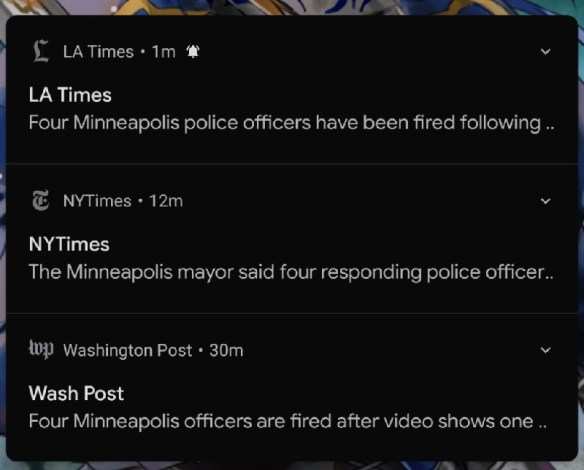
So to support #FakeNews, I have the digital access (i.e. web based / app based) subscriptions for the LA Times, the New York Times and the Washington Post.  I find it a bit amusing that the Washington Post notified me a full 18 minutes before the others two.

Screenshot1

I wonder what this says or doesn’t say about:

  • capability to obtain the news
  • productivity of the writers room
  • speed to “print” of the news

Plague, Inc

There’s this really old game called Plague, Inc.  You take control of a “plague” and need to evolve to eradicate humanity.  Very simple idea but the modeling behind the game is complex enough to warrant the CDC to invite the creators in to speak.  I would love to read or listen to the whole transcript of what was presented at this meeting.

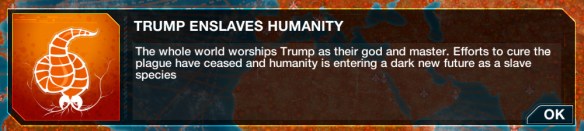
Anyways, the game has multiple “plagues” to use.  One of them is a Neurax Worm where win conditions are either to eradicate humanity or enslave humanity.  Additionally, the game allows you to “name” the plague.  So… I had a bit of fun.


Death to Human Scum!

Trump (1)

Hi, My name is Trump.  Pleased to infect you!

Trump (2)

Trump (3)


You have nothing to fear

Trump (4)

I just go around saying things and doing things.  I’m a straight shooter. I say it how it is.


Build a wall! Build a wall!

Trump (5)


Just another parasite?

Trump (6)

I’ll show you human scum. Just you wait…


Yes…

Trump (7)

Dunning Kruger has got nothing on me.


That’s right~!

Trump (8)

Fake News calling me “just a parasite” was the first wrong thing. Now you get to pay for it.


The world revolves around me and me alone!

Trump (9)

And Only I can fix this problem.  Do not forget.


Mind Control

Trump (10)

I am getting what I want.  And you can’t stop me


#MAGA2020

Trump (11)

You can never get rid of me.


Hope?

Trump (12)

Ah… so you think there’s hope?  No… I am all powerful.  You will submit to me.  It is only a matter of time.


The Final Reckoning

Trump (13)

Worship me!  Remember, I alone can save you.


All the World’s a Stage

Trump (14)

The world only talks about me now.  Any publicity is good publicity.


Ascension

Trump (15)

I am god.  People love me.

Trump (16)


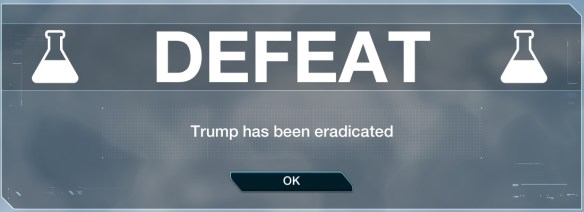
I also was defeated eradicated a few times.  Starting in USA (a 1st world nation) put me at a slight disadvantage compared to a 3rd world nation.

Trump (17)


Asian Americans Documentary on PBS

PBS has this new documentary about Asian Americans.  It’s a 5 hour long documentary.  The first 2 hours just details the rise of the early Asian Americans starting from why Asians immigrated (some would say enslaved/indentured) to work as cheap labor on the gold mining and then rail roads; the difficulties these early Asians facing societal racism and stereotypes; the suffering faced from general exclusion laws/property rights/civil liberties; and ultimately the question of American loyalty.

There’s so much to unpack in this first 2 hours of the documentary too.  Everyone can learn much from the difficulties of trying to get break out of the ethnocentric American viewpoint… or really just how racist Americans were and still are today.  Ironically though, racism in American isn’t just confined to non-whites.  When Italians immigrated due to poverty and Irish immigrated due to famine, many of the Americans who already lived in America also thought of these immigrants as low classed, dirty and the dregs of society (hey doesn’t that sound familiar?)  Have we not learned anything?  Interestingly enough, the difference between these groups of people and the current crisis… about 50-75 years and the color of the skin.  Nowadays, whether or not you have Irish or Italian ancestry is irrelevant because of you’re white skin.  If I put it in a pessimistic way, if you don’t look like 80% of the US Congress, then you realistically aren’t going to be treated equally even under laws of the US Constitution.

The following 2 hours talks about the stereotype of the “good Asian american”, continued immigration struggles, cultural and political awakenings, the “Asian” identity in times of war (Korean War/Vietnam War), and Asian American movement.  What I didn’t know was this “Chinese Confession Program” where fear of Communism spurred investigations into illegal Chinese immigrants.  Illegal because they paid for fake paperwork in order to post as a citizen’s son… similar to what you might here today regarding Green Card Marriages.  What I also didn’t know is the immigration flow of Asians really started in 1965 after many of the illegal racist exclusion laws were repealed.  Known as the Immigration and Nationality Act of 1965, one key aspect of the law allowed new immigrants to enter and gain citizenship via the “specialized skills” and allowing those who have citizenship to sponsor relatives for immigration.  I think the unintended consequence (it’s a fascinating quick read but it is left leaning) of the law was the massive migration from Hispanic and Asian countries into the US.  This literally changes the demographics of America.  Have you heard of the term “Minority Majority“?  It’s basically a term where no ethnic group will represent US as a majority sometime around 2050.

The last hour starts out with the race relations surrounding the LA riots, transitioning into the future of immigration and ending in some sort of positive note.  Regarding the riots, I remember seeing TV footage of the riots as well as clips of the Rodney King trial as a kid.  I didn’t know what was happening but I remember that a lot of Asian parents where I was growing up were closely monitoring the situation.  Growing up, I always thought the riots in Koreatown were related to the Rodney King verdict.  It never really occurred to me that race relations between Blacks and Korean Americans were so tense at the time.  This documentary revealed one of the sparks of the tension to stem from the killing of Latasha Harlins.  In a dramatic shift from race relation into immigration, the last half hour of the show discusses some of the recent immigration issues such as DACA. Apparently DACA was first proposed back in 2001 as the DREAM Act.  That’s 19 years ago.  And now we are in 2020.

If viewers achieve any insight after watching this documentary, I would hope that being a student of history is as important as being a student of morality.  Watching the documentary, I was struck how “fear” drove people to act irrationally: losing jobs to immigrants; losing the cultural identity to foreign cultures; and distrusting those that don’t look like yourself.  Yes this last one also applies to immigrants too.  But recognizing fear is just a first step to healing and educating those who are afraid.  We need more people who have the courage to stand up and become the voice of reason.  Or at the very least, a voice that forces people to stop and think.

Frank Abagnale at Google

The first  time I heard about Frank Abagnale was for a book report in 9th grade English (I think I got a B+?).  Since then, he’s had a movie produced about him and a Broadway musical too.  Google invited him to speak a few years ago.  Listening his story is pretty fascinating.  But I think the Q&A portion is much more interesting since two of the topics he discussed are very relevant today.

Here’s the full talk.

Frontline PBS Documentaries

I recently noticed Frontline PBS put out documentaries on YouTube.  I’m not sure how long they’ve been doing these documentaries but it only recently popped up on my YouTube suggestions.  This documentary about Jeff Bezos and Amazon is pretty interesting.  It’s worth a listen if you have 2 hours.


Netflix Explains COVID-19

Netflix has a new documentary on what is COVID-19 disease.  It’s a nice synopsis of everything the scientists currently know about the disease COVID-19 as well as the SARS-COV-2 virus that causes this disease.  And… there’s still a lot the scientists do not know.  If you still don’t think this pandemic is not “really that bad” and you want to “open up for business,”  this should be a mandatory watch for all of you.  I hope you change your mind after this.

However if you insist on still wanting to get out and open for business, please do everyone a favor and decline ANY AND ALL medical attention.  If you openly defy sound scientific advice, then naturally you should also not seek these scientific based medical attention that could save your life.  After all, the limited resources should be going to those essential workers (healthcare, grocery, restaurant workers) who were taking all the necessary precautions and were infected by the dummies who believed their freedoms were being “trampled on.”

There is no freedom from death.  There is no freedom when dead.