I recently stumbled upon this fascinating YouTube video (https://www.youtube.com/watch?v=utt-KnIMB3o) discussing Madrid’s 4 YEAR, $9 BILLION USD, 35 MILE metro expansion success and how they did it…
– the government supported the consturction efforts (including facilitating permits and passing laws to expedite progress)
– a small team of engineers met daily sharing experiences/issues
– the same engineers were empowered to make value-based procurement decisions that prioritized the timeline, cost and efficiency of building of the rail network
– embracing a standardized design saved money by prioritizing the user experiences (wide corridors) over aesthetically pleasing architecture.
– gaining operational efficiency leads to faster completion time that minimizes the risk of not completing on time.
– finishing the project was important to their final boss stakeholder: Madrid’s metro riding population.
– the video posits that being able to build good and fast ultimately makes the project cheaper since there will be less chance for cost over runs.
The video also includes a comparison’s of the the NYC 2nd avenue subway (WIKI) and the US “efficiencies” encountered when work actually began. Let’s also compare that to LA’s Metro system and the California High Speed Rail…
Sad Case Study 1:
The LA Metro D line extension (WIKI) has been in the works well before 2010 for “environmantel impact assessment” and didn’t start work until 2012. With a total mileage of just around 9 miles underground, the first section of 4 miles only recently opened in May 2026 (click here). The 2nd and 3rd section are slated to open in 2027. Thankfully, he tunneling is finished (click here) and all thats “left to do” are to build out the stations. That’s 15+ years of planning, tunneling and construction. And at what cost? 9.5B according to this article. (click here)
Sad Case Study 2:
LAX People Mover aka SKYLINK (WIKI) is I think a game changing LAX infrastructure upgrade that is LONG OVERDUE. The days of having to navigate the horrendous “U Loop / Horseshoe” (link1, link2) are numbered with this people mover. Starting in 2018, the ~2.5 mile loop into and out of LAX was originally slated to be opened in 2023 and now has been slowly pushed back to Oct 2026 (hopefully?). This project has been mired in litigation resulting in continual delays. (link). This YouTube video does a good job explaining the cause of the delays (part of is how the contract was designed).
Potentially unpopular opinion….
Once this opens, I think anyone using rideshare service to fly in or out of LAX MUST be dropped off / picked up at one of the outside station and utilize the people mover to enter/leave the LAX terminals. Additionally, curbside pick up and drop off should be banned. Although this might be difficult to enforce without cameras and auto-ticketing systems. If one does want to pick up or drop off travelers, then they should be forced to park in the garages. Hotel and Car Park shuttles can remain in use as is. This should ease the congestion on the horsehoe.
Sad Case Study 3:
California High Speed Rail. If you’ve lived in California for the past 25+ years… you know about this disastrous public infrastructure works. Since 2008, it’s incurred over $230 BILLION with no real visible achievements (link).
Oh… just for comparison, in 2008 China had started construction on its first(?) high speed rail line of 1300 KM (800 miles). They finished in 2011. In 2026, China has over 50,000 KM (31,100 miles) (link) of rail connecting pretty much all of China together (I think). For comparison, LA to SF by car is almost 400 miles. The LA to SF high speed rail would have covered approximately 500 miles of rail (link). As of 2026, there is no true high speed rail like that of China that can be found in US.
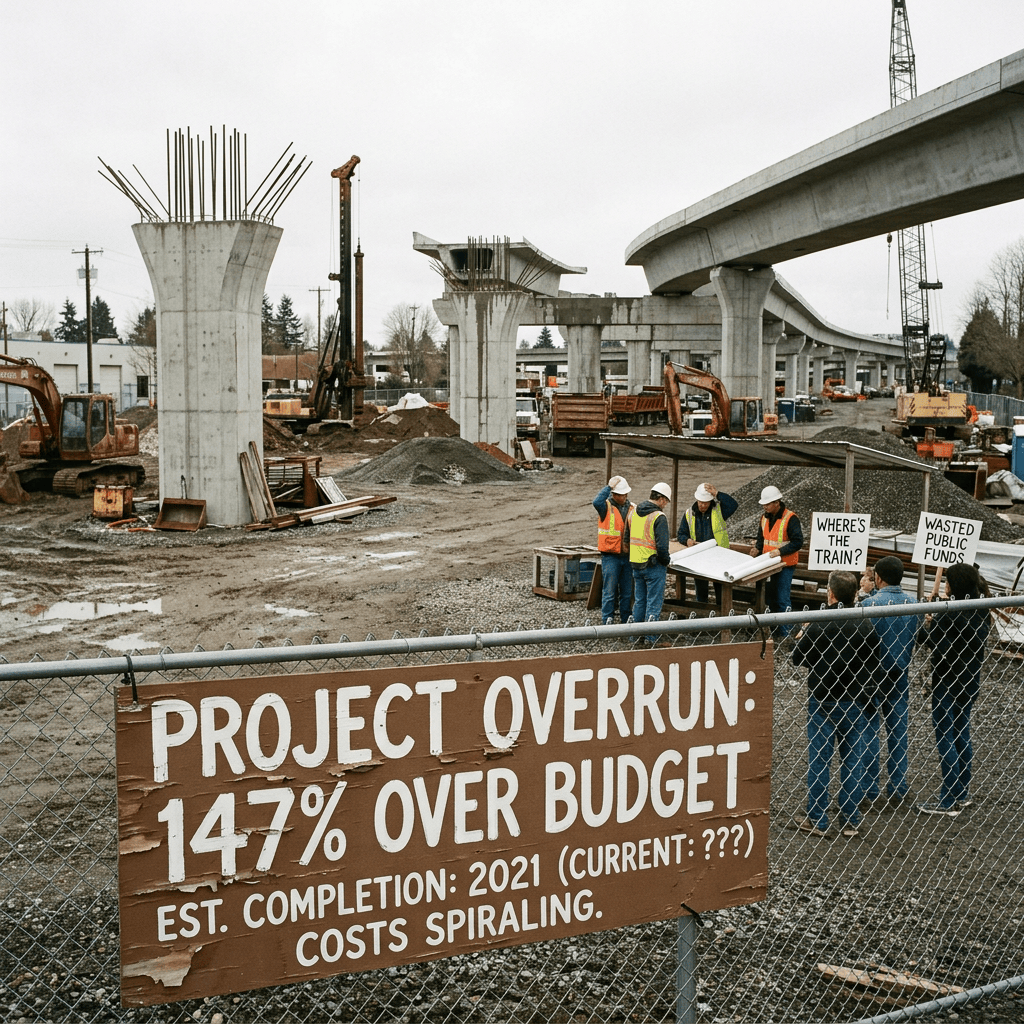
How can it be a country that claims to be a great nation can’t even get infrastructure projects completed ON TIME and ON BUDGET. AI generated images are fun.