Terms of Service

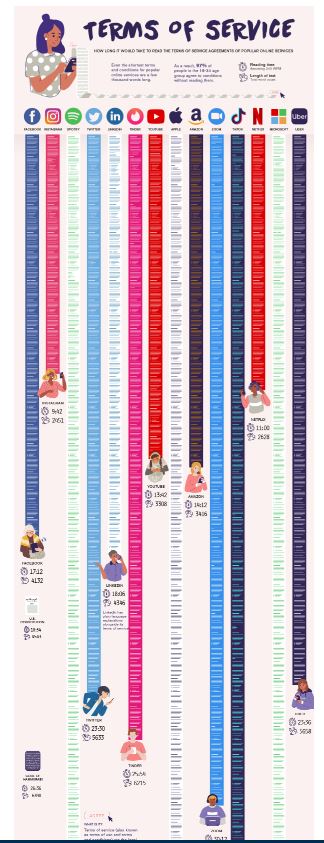
Holy crap… this pic is from the article (https://www.visualcapitalist.com/terms-of-service-visualizing-the-length-of-internet-agreements/) and it’s been zoomed out to 25% on Google Chrome.  And it still doesn’t doesn’t see the bottom of Spotify, Apple, TikTok and Microsoft.  Why can’t Terms of Service (TOS) be shorter and simpler to read?  Who actually reads the TOS?  No one because it’s too fucking long and moderately complex enough to discourage reading.

Ultimately, you(me) are the product for all these services.


Capture16


Coffee and Climate change

If you drink love coffee, then you should consider climate change as real.  Some people might not think climate change is real, but would you really risk coffee for something you “don’t think it’s real”?


Successes from Quick Action

Today, I saw an old article from CNN that details some of the reasons as to how Vietnam has been able to control COVID-19.

  • Quick government action
  • Swift travel restrictions
  • Quarantine/lock down of cities as needed
  • Aggressive contact tracing
  • Public communication of location where new cases occurred
  • Government mandated face masks and social distancing requirements
  • A general population that understand the risks of infection and more importantly accepting the temporary inconveniences to control COVID-19


How would you handle COVID-19?

Since hindsight is 20/20… this is what I would have done with COVID-19.

In late January, announce that the international borders will be closed within 10 hours of the announcement.  The 10 hour buffer allows any current en route flights to land without issue.  Empty inbound international flights are still allowed in order to accommodate any outbound international flights.  The crews from these inbound flights will be sequestered to just two or three hotels only.  This action isolates the crew so to allow contact tracing to be easier in case of outbreaks.  Domestic travel can still operate normally until otherwise told.

I think if just this measure was put in place there might not have been an outbreak in both Seattle and New York.  It’s still possible the cases could appear as there were only 15 confirmed cases back on Feb 15, 2020.  Given the incubation length and the potentila asymptomatic transmission possibility, a January closure would have mitigated the most damage.  According to the NY times interactive modeling, the 15 early cases were linked to transmission from China.  However, what’s more important is that any subsequent cases would be linked to these 15 cases AND there would be no new influx of cases.  Although travel was restricted from China on Feb 02, 2020, restrictions were imposed far too late from Europe on Mar 13, 2020.  Between late January and mid-March, countless travelers passed through the international airports and silently spreading the infection.  Through genetic testing, the outbreak in New York was linked to a European strain.  It shows just how partial restrictions are pointless.

If these borders were to have been closed in late January, I see a number of different scenarios that would be different

  • COVID-19 cases would be limited and probably very manageable by the healthcare professionals
  • Stay-at-Home requirements might never have been issued
  • Businesses would remain open
  • Healthcare system would function at normal capacity without needing to be in constant emergency “war zone” mode
  • No Masks
  • No Social Distancing

What would you do?

Stay-at-Home again…

California is re-imposing the restrictions of gathering indoors.  As long as COVID-19 is not under control, outbreaks will continue to happen.  There are a few effective ways to limit transmission…

  1. Stay at home as much as possible.
  2. Wear a mask if you go outside.
  3. Limit outdoor activities to a minimum including grocery shopping, food takeout, etc.


Asian Enough: Kamala Harris

I posted sometime ago about LA Times’ Asian Enough podcast.  This past week they interviewed California’s US Senator Kamala Harris.  For those that might not know, Senator Harris is half Asian (Indian) and half Black (Jamaican).  She was also one of the many Democratic candidates for the 2020 Presidential race.

This podcast gives great insight into Senator Harris as a person as opposed to a presidential candidate or senator.  It’s worth listening to.

https://www.latimes.com/california/story/2020-03-10/asian-enough-podcast


Use of Masks

Kudos to the California government on the proclamation requiring residents to wear face masks in public.  Masks have been shown to minimize the transmission probability down to 1.5%.  Unfortunately, the general anti-mask populace doesn’t seem to really understand the depth of the problem and are only thinking of themselves and their own livelihood.

One of the challenges with COVID-19 is the fact that people could be infected with COVID-19 without ever getting sick or displaying symptoms.  These are known as asymptomatic carriers.  Furthermore, another challenge is the fact that you could still be infecting others before displaying any of the COVID-19 symptoms.  Both of these reasons are some of the factors as to why COVID-19 very difficult to deal with.  Think about it… you are infected without realizing you’re infected.  And you’re infecting other people all while you have no idea that you’ve been infected.  That’s scary.

One of the effective ways to minimize transmission rates is to not see anyone.  These were the stay at home orders issued by most states.  Another way to minimize transmission rate is to wear masks.  The picture below represents approximate transmission rates for different situations.  Since staying at home full time is not possible (people need to shop for groceries, check up on family living nearby, etc), wearing mask is also another effective way to minimize the transmission rate.

Since a person infected with COVID-19 might not even know they’re infected, wearing a masks not only protects you from getting infected by others, but it also protects others from getting infected by you!  Wearing masks protects everyone whether you know it or not.  An ounce of prevention (wearing masks) is worth a pound of cure (becoming infected and requiring hospitalization)!

So… Wear masks. Save lives.

COVID19 Transmission

Re: Atlanta

You would think with ALL THE PROTEST going on that the police would assume a measured approach to any situations that require police assistance. You would think…

Barack Obama’s Response

Here is Barack Obama’s Medium post (found here) talking about the recent nationwide protest.  I agree with President Obama and have always believed in the need to start wielding political power in order to affect change.  Without political power, the status quo will always remain for those in power.

https://medium.com/@BarackObama/how-to-make-this-moment-the-turning-point-for-real-change-9fa209806067

View at Medium.com

As millions of people across the country take to the streets and raise their voices in response to the killing of George Floyd and the ongoing problem of unequal justice, many people have reached out asking how we can sustain momentum to bring about real change.

Ultimately, it’s going to be up to a new generation of activists to shape strategies that best fit the times. But I believe there are some basic lessons to draw from past efforts that are worth remembering.

First, the waves of protests across the country represent a genuine and legitimate frustration over a decades-long failure to reform police practices and the broader criminal justice system in the United States. The overwhelming majority of participants have been peaceful, courageous, responsible, and inspiring. They deserve our respect and support, not condemnation — something that police in cities like Camden and Flint have commendably understood.

On the other hand, the small minority of folks who’ve resorted to violence in various forms, whether out of genuine anger or mere opportunism, are putting innocent people at risk, compounding the destruction of neighborhoods that are often already short on services and investment and detracting from the larger cause. I saw an elderly black woman being interviewed today in tears because the only grocery store in her neighborhood had been trashed. If history is any guide, that store may take years to come back. So let’s not excuse violence, or rationalize it, or participate in it. If we want our criminal justice system, and American society at large, to operate on a higher ethical code, then we have to model that code ourselves.

Second, I’ve heard some suggest that the recurrent problem of racial bias in our criminal justice system proves that only protests and direct action can bring about change, and that voting and participation in electoral politics is a waste of time. I couldn’t disagree more. The point of protest is to raise public awareness, to put a spotlight on injustice, and to make the powers that be uncomfortable; in fact, throughout American history, it’s often only been in response to protests and civil disobedience that the political system has even paid attention to marginalized communities. But eventually, aspirations have to be translated into specific laws and institutional practices — and in a democracy, that only happens when we elect government officials who are responsive to our demands.

Moreover, it’s important for us to understand which levels of government have the biggest impact on our criminal justice system and police practices. When we think about politics, a lot of us focus only on the presidency and the federal government. And yes, we should be fighting to make sure that we have a president, a Congress, a U.S. Justice Department, and a federal judiciary that actually recognize the ongoing, corrosive role that racism plays in our society and want to do something about it. But the elected officials who matter most in reforming police departments and the criminal justice system work at the state and local levels.

It’s mayors and county executives that appoint most police chiefs and negotiate collective bargaining agreements with police unions. It’s district attorneys and state’s attorneys that decide whether or not to investigate and ultimately charge those involved in police misconduct. Those are all elected positions. In some places, police review boards with the power to monitor police conduct are elected as well. Unfortunately, voter turnout in these local races is usually pitifully low, especially among young people — which makes no sense given the direct impact these offices have on social justice issues, not to mention the fact that who wins and who loses those seats is often determined by just a few thousand, or even a few hundred, votes.

So the bottom line is this: if we want to bring about real change, then the choice isn’t between protest and politics. We have to do both. We have to mobilize to raise awareness, and we have to organize and cast our ballots to make sure that we elect candidates who will act on reform.

Finally, the more specific we can make demands for criminal justice and police reform, the harder it will be for elected officials to just offer lip service to the cause and then fall back into business as usual once protests have gone away. The content of that reform agenda will be different for various communities. A big city may need one set of reforms; a rural community may need another. Some agencies will require wholesale rehabilitation; others should make minor improvements. Every law enforcement agency should have clear policies, including an independent body that conducts investigations of alleged misconduct. Tailoring reforms for each community will require local activists and organizations to do their research and educate fellow citizens in their community on what strategies work best.

But as a starting point, here’s a report and toolkit developed by the Leadership Conference on Civil and Human Rights and based on the work of the Task Force on 21st Century Policing that I formed when I was in the White House. And if you’re interested in taking concrete action, we’ve also created a dedicated site at the Obama Foundation to aggregate and direct you to useful resources and organizations who’ve been fighting the good fight at the local and national levels for years.

I recognize that these past few months have been hard and dispiriting — that the fear, sorrow, uncertainty, and hardship of a pandemic have been compounded by tragic reminders that prejudice and inequality still shape so much of American life. But watching the heightened activism of young people in recent weeks, of every race and every station, makes me hopeful. If, going forward, we can channel our justifiable anger into peaceful, sustained, and effective action, then this moment can be a real turning point in our nation’s long journey to live up to our highest ideals.

Let’s get to work.

View at Medium.com