I haven’t heard John Oliver swear so much in an episode until this one.

I haven’t heard John Oliver swear so much in an episode until this one.
June’s Angels Cup are Burundi beans from Manzanita Roasting Company. One benefit of these monthly coffee bags is that I’m starting to learn some of the locations of these countries in Africa. Although it is a small region of Kenya, Ethiopia, Rwanda and Burundi. Most of the beans that have arrived originate from Ethiopia.
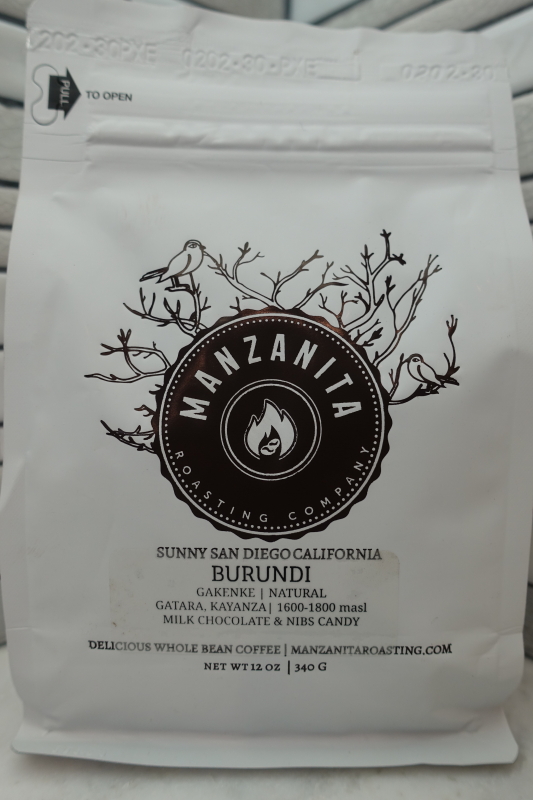
The beans release a faint floral and fruity aroma upon opening the bag. Making my latte, I taste this subtle cocoa flavor that changes to this wonder earthy nutty flavor at the back of my tongue. What’s interesting is with each sip, that cocoa flavor becomes more intense. The flavor is similar to that lingering taste after eating chocolate and peanut butter (like a Reese’s Peanut Butter Cup).
Here is Barack Obama’s Medium post (found here) talking about the recent nationwide protest. I agree with President Obama and have always believed in the need to start wielding political power in order to affect change. Without political power, the status quo will always remain for those in power.
As millions of people across the country take to the streets and raise their voices in response to the killing of George Floyd and the ongoing problem of unequal justice, many people have reached out asking how we can sustain momentum to bring about real change.
Ultimately, it’s going to be up to a new generation of activists to shape strategies that best fit the times. But I believe there are some basic lessons to draw from past efforts that are worth remembering.
First, the waves of protests across the country represent a genuine and legitimate frustration over a decades-long failure to reform police practices and the broader criminal justice system in the United States. The overwhelming majority of participants have been peaceful, courageous, responsible, and inspiring. They deserve our respect and support, not condemnation — something that police in cities like Camden and Flint have commendably understood.
On the other hand, the small minority of folks who’ve resorted to violence in various forms, whether out of genuine anger or mere opportunism, are putting innocent people at risk, compounding the destruction of neighborhoods that are often already short on services and investment and detracting from the larger cause. I saw an elderly black woman being interviewed today in tears because the only grocery store in her neighborhood had been trashed. If history is any guide, that store may take years to come back. So let’s not excuse violence, or rationalize it, or participate in it. If we want our criminal justice system, and American society at large, to operate on a higher ethical code, then we have to model that code ourselves.
Second, I’ve heard some suggest that the recurrent problem of racial bias in our criminal justice system proves that only protests and direct action can bring about change, and that voting and participation in electoral politics is a waste of time. I couldn’t disagree more. The point of protest is to raise public awareness, to put a spotlight on injustice, and to make the powers that be uncomfortable; in fact, throughout American history, it’s often only been in response to protests and civil disobedience that the political system has even paid attention to marginalized communities. But eventually, aspirations have to be translated into specific laws and institutional practices — and in a democracy, that only happens when we elect government officials who are responsive to our demands.
Moreover, it’s important for us to understand which levels of government have the biggest impact on our criminal justice system and police practices. When we think about politics, a lot of us focus only on the presidency and the federal government. And yes, we should be fighting to make sure that we have a president, a Congress, a U.S. Justice Department, and a federal judiciary that actually recognize the ongoing, corrosive role that racism plays in our society and want to do something about it. But the elected officials who matter most in reforming police departments and the criminal justice system work at the state and local levels.
It’s mayors and county executives that appoint most police chiefs and negotiate collective bargaining agreements with police unions. It’s district attorneys and state’s attorneys that decide whether or not to investigate and ultimately charge those involved in police misconduct. Those are all elected positions. In some places, police review boards with the power to monitor police conduct are elected as well. Unfortunately, voter turnout in these local races is usually pitifully low, especially among young people — which makes no sense given the direct impact these offices have on social justice issues, not to mention the fact that who wins and who loses those seats is often determined by just a few thousand, or even a few hundred, votes.
So the bottom line is this: if we want to bring about real change, then the choice isn’t between protest and politics. We have to do both. We have to mobilize to raise awareness, and we have to organize and cast our ballots to make sure that we elect candidates who will act on reform.
Finally, the more specific we can make demands for criminal justice and police reform, the harder it will be for elected officials to just offer lip service to the cause and then fall back into business as usual once protests have gone away. The content of that reform agenda will be different for various communities. A big city may need one set of reforms; a rural community may need another. Some agencies will require wholesale rehabilitation; others should make minor improvements. Every law enforcement agency should have clear policies, including an independent body that conducts investigations of alleged misconduct. Tailoring reforms for each community will require local activists and organizations to do their research and educate fellow citizens in their community on what strategies work best.
But as a starting point, here’s a report and toolkit developed by the Leadership Conference on Civil and Human Rights and based on the work of the Task Force on 21st Century Policing that I formed when I was in the White House. And if you’re interested in taking concrete action, we’ve also created a dedicated site at the Obama Foundation to aggregate and direct you to useful resources and organizations who’ve been fighting the good fight at the local and national levels for years.
I recognize that these past few months have been hard and dispiriting — that the fear, sorrow, uncertainty, and hardship of a pandemic have been compounded by tragic reminders that prejudice and inequality still shape so much of American life. But watching the heightened activism of young people in recent weeks, of every race and every station, makes me hopeful. If, going forward, we can channel our justifiable anger into peaceful, sustained, and effective action, then this moment can be a real turning point in our nation’s long journey to live up to our highest ideals.
Let’s get to work.
A friend of mine recently share this article with me. It’s a powerful essay from a young Asian American in a time when racial divisiveness is at an all time high. Please share the link.
Taken from this source. https://chineseamerican.org/p/31571
Content warning: White supremacy, racial stereotypes, violence
To the Chinese American Community:
My name is Eileen Huang, and I am a junior at Yale University studying English. I was asked to write a reflection, maybe even a poem, on Chinese American history after watching Asian Americans, the new documentary on PBS. However, I find it hard to write poems at a time like this. I refuse to focus on our history, our stories, and our people without acknowledging the challenges, pain, and trauma experienced by marginalized people—ourselves included—even today. In light of protests in Minnesota, which were sparked by the murder of George Floyd at the hands of racist White and Asian police officers, I specifically want to address the rampant anti-Blackness in the Asian American community that, if unchecked, can bring violence to us all.
We Asian Americans have long perpetuated anti-Black statements and stereotypes. I grew up hearing relatives, family friends, and even my parents make subtle, even explicitly racist comments about the Black community: They grow up in bad neighborhoods. They cause so much crime. I would rather you not be friends with Black people. I would rather you not be involved in Black activism.
The message was clear: We are the model minority—doctors, lawyers, quiet and obedient overachievers. We have little to do with other people of color; we will even side with White Americans to degrade them. The Asian Americans around me, myself included, were reluctant—and sometimes even refused—to participate in conversations on the violent racism faced by Black Americans—even when they were hunted by White supremacists, even when they were mercilessly shot in their own neighborhoods, even when they were murdered in broad daylight, even when their children were slaughtered for carrying toy guns or stealing gum, even when their grieving mothers appeared on television, begging and crying for justice. Even when anti-Blackness is so closely aligned to our own oppression under structural racism.
We Asian Americans like to think of ourselves as exempt from racism. After all, many of us live in affluent neighborhoods, send our children to selective universities, and work comfortable, professional jobs. As the poet Cathy Park Hong writes, we believe that we are “next in line … to disappear,” to gain the privileges that White people have, to be freed from all the burdens that come with existing in a body of color.
However, our survival in this country has always been conditional. When Chinese laborers came in the 1800s, they were lynched and barred from political and social participation by the Chinese Exclusion Act—the only federal law in American history to explicitly target a racial group. When early Asian immigrants, such as Bhagat Singh Thind, attempted to apply for citizenship, all Asian Americans were denied the right to legal personhood—which was only granted to “free white persons“—until 1965. When Pearl Harbor was bombed, Japanese Americans were rounded up, tortured, and detained in concentration camps. When the Cold War reached its peak, Chinese Americans suspected of being Communists were terrorized by federal agents. Families lost their jobs, businesses, and livelihoods. When COVID-19 hit the US, Asian Americans were assaulted, spat on, and harassed. We were accused of being “virus carriers”; I was recently called a “bat-eater.” We are made to feel like we have excelled in this country until we are reminded that we cannot get too comfortable—that we will never truly belong.
Here’s a story of not belonging: On June 19, 1982, as Detroit’s auto industry was deteriorating from Japanese competition, Vincent Chin, a 27-year-old Chinese American, entered a bar to celebrate his upcoming wedding. Ronald Ebens, a laid-off White autoworker, and his stepson, Michael Nitz, were there as well. They followed Chin as he left the bar and cornered him in a McDonald’s parking lot, where they proceeded to bludgeon him with a metal baseball bat until his head cracked open. “It’s because of you motherf––ers that we are out of work,” they had said to Chin. Later, as news of the murder got out, Chinese Americans were outraged, calling for Ebens and Nitz’s conviction. Chin’s killers were only charged for second-degree murder, receiving only charges of $3,000—and no jail time. “These weren’t the kind of men you send to jail,” County Judge Charles Kaufman said. Then who is?
Watching Asian Americans, I was haunted by the video clips of Chin’s mother, Lily. She is a small Chinese woman who looks like my grandmother, or my mother, or an aunt. Her face crumples in front of the cameras; she pleads and cries, in a voice almost animal-like, “I want justice for my son.” Yet, in all of Lily’s footage, she is surrounded by Black civil rights activists, such as Jesse Jackson. They guard her from news reporters that try to film her grief. Later, they march in the streets with Chinese American activists, holding signs calling for an end to racist violence.
Though we cannot compare the challenges faced by Asian Americans to the far more violent atrocities suffered by Black Americans, we owe everything to them. It is because of the work of Black Americans—who spearheaded the civil rights movement—that Asian Americans are no longer called “Orientals” or “Chinamen.” It is because of Black Americans, who called for an end to racist housing policies, that we are even allowed to live in the same neighborhoods as White people. It is because of Black Americans, who pushed back against racist naturalization laws, that Asian Americans have gained official citizenship and are officially recognized under the law. It is because of Black activism that stories like Vincent Chin’s are even remembered. We did not gain the freedom to become comfortable “model minorities” by virtue of being better or hard-working, but from years of struggle and support from other marginalized communities.
On May 25, 2020, George Floyd, a Black man, was accused of using a counterfeit 20-dollar bill at a deli in Minneapolis. In response, Derek Chauvin, a White police officer, tackled Floyd and knelt on his neck for seven minutes. In videos that will later circulate online, for three minutes, in a pool of his own blood, Floyd is seen pleading for his life, stating that he can no longer breathe. Instead, Chauvin continues to kneel. And kneel. Meanwhile, in the background, Tou Thao, an Asian American police officer, is seen standing by the murder, merely watching. And watching. And saying nothing as Floyd slowly stops struggling.
I see this same kind of silence from Asian Americans around me. I am especially disappointed in the Chinese American community, whose silence on the murder of Black Americans has been deafening. While so many activists of color are banding together to support protesters in Minneapolis, so many Chinese Americans have chosen to “stay out” of this disobedience. The same Chinese Americans who spoke out so vocally on anti-Asian racism from COVID-19 are suspiciously quiet when it comes to Floyd’s murder (as well as Ahmaud Arbery, Breonna Taylor, Tamir Rice, Sandra Bland, Trayvon Martin, Michael Brown, Freddie Gray and countless other Black Americans who were killed merely for existing). I do not see us sharing sympathy for Black mothers who appear on television, begging, like Lily Chin, to see justice for their sons. I do not see us marching with Black protesters. I do not see us donating to Black-led organizations.
I do not see our outrage as White murderers, such as Vincent Chin’s killers, receive no jail time for killing innocent Black Americans. I do not see us extending any solidarity toward the Black protesters who have been sprayed with tear gas and rubber bullets—only a couple weeks after White COVID-19 “protesters,” armed with AR-15s, were barely even touched by policemen. Instead, I see us calling them “thugs,” “rioters,” “looters”—the same epithets that White Americans once called us. I see us, such as members of my own family, merely laughing off President Trump’s tweet about sending the National Guard to Minnesota, as if it were a joke and not a deadly threat.
I imagine where we would be if Black Americans did not participate in Asian American activism. We would still be called Orientals. We would live in even more segregated neighborhoods and attend even more segregated schools. We would not be allowed to attend these elite colleges, advance in our comfortable careers. We would be illegal aliens. We—and everyone else—would not remember stories like Vincent Chin’s.
I urge all Chinese Americans to watch media such as Asian Americans, to seriously reflect not only on our own history, but also on our shared history with other minorities—how our liberation is intertwined with liberation for Black Americans, Native Americans, Latinx Americans, and more. We are not exempt from history. What has happened to George Floyd has happened to Chinese miners in the 1800s and Vincent Chin, and will continue to happen to us and all minorities unless we let go of our silence, which has never protected us, and never will.
Our history is not only a lineage of obedient doctors, lawyers, and engineers. It is also a history of disrupters, activists, fighters, and, above all, survivors. I think often of Yuri Kochiyama, a Japanese American survivor of internment camps who later became a prominent civil rights activist, and who developed close relationships with Black activists, such as Malcolm X. “We are all part of one another,” she once said.
I urge you all to donate to the activist organizations listed below. I refuse to call for the racial justice of our own community at the expense of others. Justice that degrades or subordinates other minorities is not justice at all. At a time when many privileged minorities are siding with White supremacy—which has terrorized all of our communities for centuries—I want to ask: Whose side are you on?
Can we treat each other as we want to be treated?
As a kid, I remember watching the 1992 LA riots. At that time, I didn’t know what was going on except it was somehow related to the Rodney King verdict. Almost 30 years later and the constant needless deaths from the unnecessary police violence, the spark from George Floyd’s death literally ignited a firestorm of pent up frustrations and anger.
Can I just say… all the reforms people have talked about and implemented… clearly have not been working to the degree that it should. Have they been working? I’m sure they have. But even after 30 years, shouldn’t there already be significant change in the system already across the country? Even with the change, how much longer do people have to suffer? Will another year, or 10 years, do any good?
Here’s what I’m thinking, what if society, over a one month period, replaced all the white police officers with minorities (i.e. non-Caucasians) and see how this social experiment goes for another 30 years? Oh is 30 years too long? Well tough shit, maybe these reforms should have been taken more seriously.
So why 30 years? Let’s mark the Rodney King beating as the start of all the “reforms” since if you really think about it, the taped recording (very violent) was the first “social media posting” of police brutality and violence towards a person of color. Let’s make George Floyd’s death the final bookend to the past three decades of pain, anguish and anger.
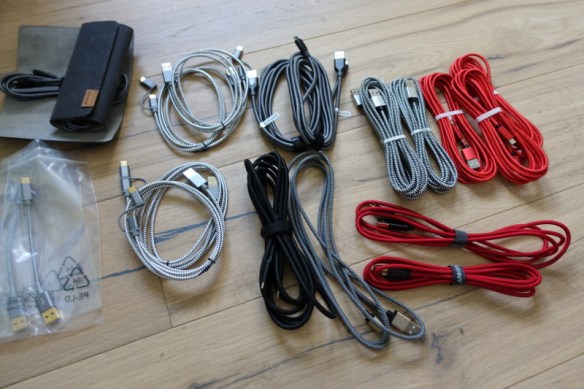
Perhaps an effect of the work from home requirements, I’ve been somewhat dissatisfied about my current mix of USB cable situation. I started to categorize all the various cables, cable lengths, and USB Type connectors currently in my cable box. At the same time, I also frivolously decided that nylon braided USB cables sparks joy (maybe?) over the current PVC wrapped cables. The 6ft and 10ft braided cables I had bought a few years ago have held up pretty well. They’re nice to touch and are definitely much more flexible than the PVC wrapped ones.


The result? I have these new braided cables (not all shown) while also keeping most of the wall chargers, USB hubs, and travel adapters.
So to support #FakeNews, I have the digital access (i.e. web based / app based) subscriptions for the LA Times, the New York Times and the Washington Post. I find it a bit amusing that the Washington Post notified me a full 18 minutes before the others two.
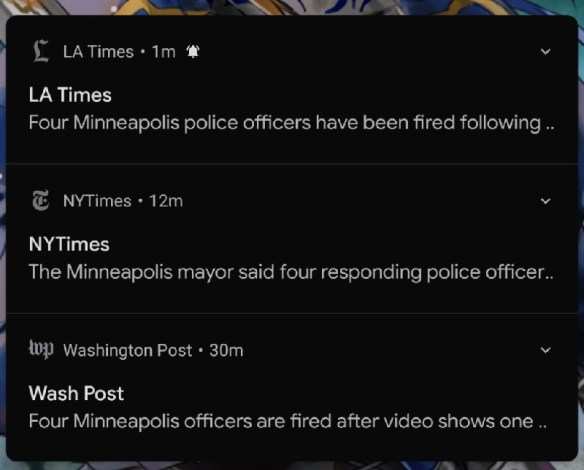
I wonder what this says or doesn’t say about:
There’s this really old game called Plague, Inc. You take control of a “plague” and need to evolve to eradicate humanity. Very simple idea but the modeling behind the game is complex enough to warrant the CDC to invite the creators in to speak. I would love to read or listen to the whole transcript of what was presented at this meeting.
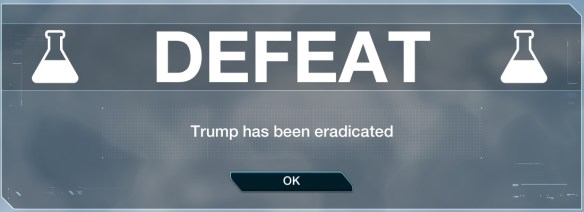
Anyways, the game has multiple “plagues” to use. One of them is a Neurax Worm where win conditions are either to eradicate humanity or enslave humanity. Additionally, the game allows you to “name” the plague. So… I had a bit of fun.
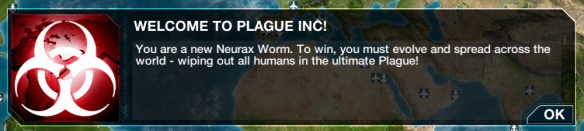
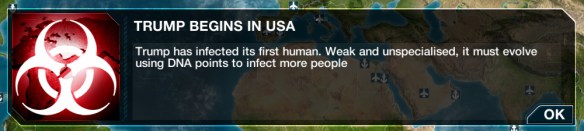


I just go around saying things and doing things. I’m a straight shooter. I say it how it is.


I’ll show you human scum. Just you wait…

Dunning Kruger has got nothing on me.
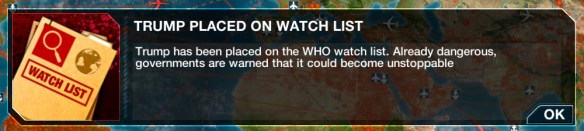
Fake News calling me “just a parasite” was the first wrong thing. Now you get to pay for it.

And Only I can fix this problem. Do not forget.

I am getting what I want. And you can’t stop me

You can never get rid of me.

Ah… so you think there’s hope? No… I am all powerful. You will submit to me. It is only a matter of time.

Worship me! Remember, I alone can save you.

The world only talks about me now. Any publicity is good publicity.
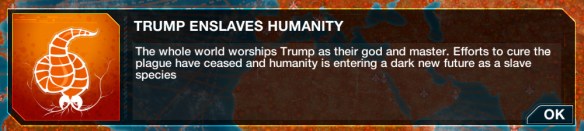

I also was defeated eradicated a few times. Starting in USA (a 1st world nation) put me at a slight disadvantage compared to a 3rd world nation.
May’s Angels Cup comes from Sunergos Coffee. I’ve been sent their roasted beans before and they’ve been pretty good. This time around these beans are from Brazil whereas previous beans had been from Africa.

Opening the bag, I’m greeted with this overwhelming nutty aroma that dissipates into this wonderful floral smell. Grinding the beans releases a more earthy smell that overpowers this faint sweet caramel/chocolate smell. Sipping my latte, I taste this amazing nutty and caramel flavor with bits of honey and brown sugar. I think this will be another one of those enjoyable coffees for the next few weeks.
 A Guy and His Thoughts...