This is great. The Daily Show talks about a number of different topics on the panel.

This is great. The Daily Show talks about a number of different topics on the panel.
Somehow despite all the Google searches, Google’s algorithm still can’t decipher which IU I’m looking for…

Well I’ve never seen this before. Asking for a Captcha in order to unsubscribe…

I think it’s time to get and wear a watch again. I used to wear one but with the invention of the smartphone, the smartphone becomes the watch. In the past years, I never really needed a watch before but recently I’ve been having what could be described as “Time Anxiety.” It’s a feeling that I’m going to miss something important because I didn’t notice the time and I feel self conscious about taking out my smartphone to especially when I’m talking to people who are at a much higher pay grade than me.
I’ve been researching watches and watch brands. I’m going to stay away from the smart watches. I’ve always been amazed at the Automatic/Kinetic watches where the movement of the arm powers the watch. I also don’t want too expensive of a watch but I’m not sure what my price point is at the moment. Ideally I’d also like a small case. It seems like most men’s watches seem to be around 42mm case which I feel is pretty huge on the wrist.
It’s an hour long interview with Jeff Bezos covering all things Bezos or Amazon. Hearing his thoughts on these random topics is pretty fascinating.
On YouTube, I saw a Vox vlog about those ubiquitous e-scooters. Vox quickly went into the history of sidewalks and how the sidewalks have ended up in their present day format. Although I agree with the idea of e-scooter startups and their bet on the “last mile problem” in public transportation, I don’t think the solution of “complete streets” is really viable.
Behavior of the masses is hard to change. If people want to drive then they will find a way to drive regardless if there are other viable option. To be honest, I sometimes feel that the 405 expansion seems to have only increased the traffic through the Sepulveda pass.
In my opinion, the most viable alternative would be to convert existing streets into bus only traffic, or add rail lines extending the network of public transportation. And then convert the remaining street space into bike/scooter/last mile alternative only lanes. By eliminating the car lane completely, local/county government are actively encouraging people to walk/bike/run on these car free zones while also promoting the public transportation option. Since the bus-only/rail transit are not competing against car traffic, they should be able to zip through neighborhoods much faster and not be tied up in car traffic jams.
And to be honest, being able to safely bike or even rollerblade from DTLA to SaMo would be legitimately something I want to do.
I came across a news article saying that the Pew Research Center had this interactive income calculator to determine if a person is in the middle class. It also compares the government data to the rest of the US population based on the metro area, number of household members and total household income level.
I live in the greater Los Angeles metro. I was a bit surprised to find what the upper, middle and lower income cutoffs were.
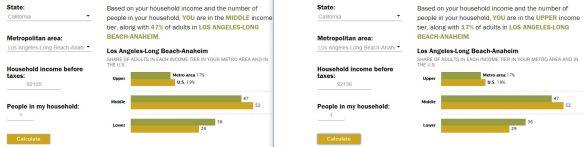
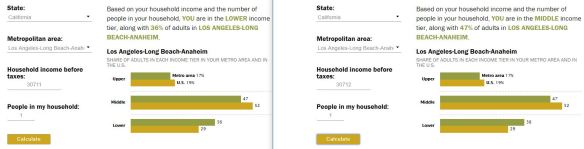
In case the screenshot print is too small…
For 1 person household in the greater LA metro, the cutoffs are: Lower < $30711 < Middle < $92135 < Upper.
A fascinating short read of the history of Chinese food over the recent past two decades. The rise of mainland Chinese cuisine (like Sichuan/Hunan cuisine) is not yet over. With China being larger than US and with “slighty” more people, the number of different cuisines yet to be exported to the US will undoubtedly change the LA Chinese food scene in years to come.
OK… so I finally got around to watching this movie. I have to say it’s such a great movie that stars pretty such an all star Asian cast. That alone makes it worth spending money on. Does it live up to they hype? Mmm… I don’t think so. At it’s heart, it’s a rom-com drama that follows pretty traditional trope story arcs but in a uniquely Asian way. But it did make 34 million in it’s opening week (Wed to Sun). #goldopen

Asians talking about Asian topics.
One of the interesting things they discussed was that Asian-Americans is a broad category that consist of people who come from India, China, Korea, Japan, Cambodia, Malaysia, Singapore, and so on. And… if you even want to go even further, you could have regional specific categorizations as well like in China. Someone from Xinjiang would have a slightly different culture than someone from Guangzhou. I’m sure that’s the case for regions in India or Malaysia too.
I think this is the best quote from the clip.
“You don’t expect one white person to represent all white people.”
 A Guy and His Thoughts...